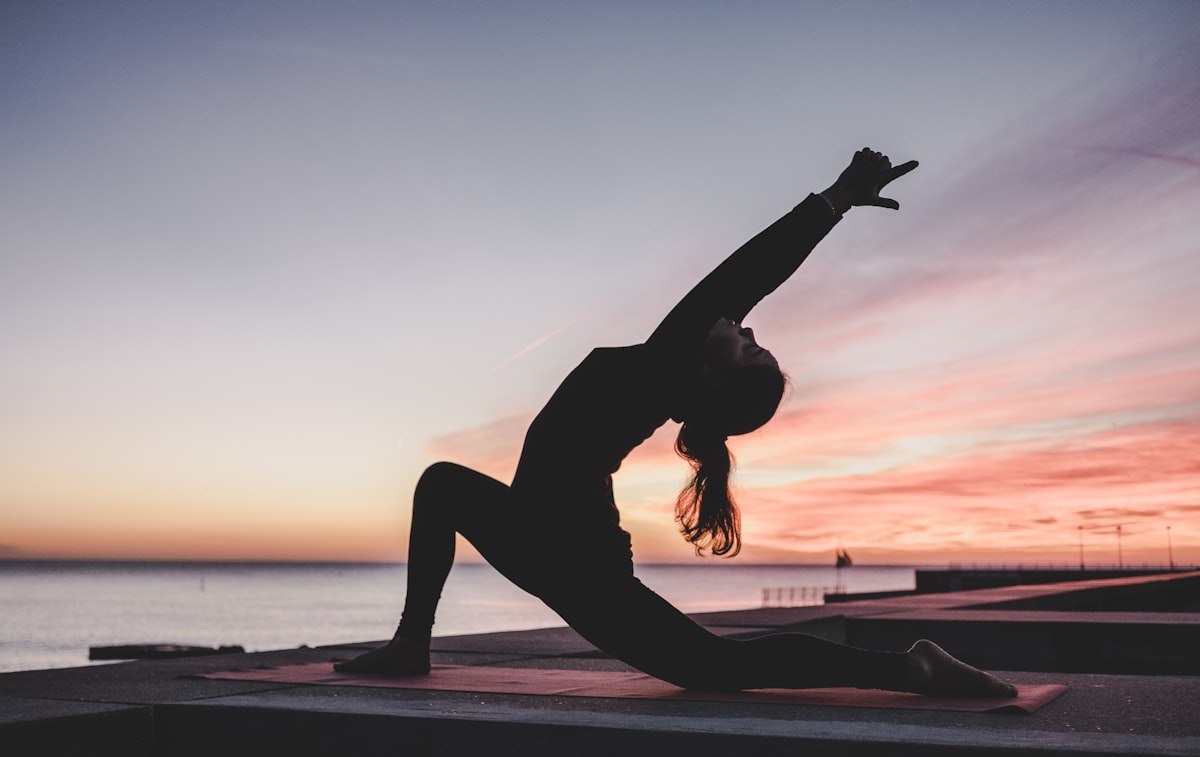
A swimmer’s shoulder does something almost no other joint in sport does: it rotates overhead, under load, thousands of times a week, while the lungs are on a timer. That is why pilates for swimmers shoulder stability and breathing is not a cross-training afterthought — it is the work that decides whether the stroke holds together in the back half of a race or quietly falls apart.
Why the shoulder gives out before the arm gets tired
The shoulder is the least bony, most mobile joint in the body. The head of the humerus sits against a socket roughly the size of a golf tee. Almost everything holding it there is soft tissue — rotator cuff, labrum, capsule, and the muscles that anchor the shoulder blade to the ribcage.
In swimming, the scapula is the real foundation. The arm can only travel cleanly overhead if the shoulder blade glides and rotates on the back of the ribcage at the right moment. When the scapula stops moving well — usually because the serratus anterior and lower trapezius are underpowered relative to the lats and pecs — the humerus starts borrowing range from the joint itself. That borrowing is what people feel as impingement, pinching at catch, or a dull ache after a heavy set.
Short answer: Pilates helps swimmers because it trains scapular control, rotator cuff endurance, thoracic mobility, and lateral rib breathing under light, sustained load — the exact qualities a freestyle stroke demands and that pool volume alone tends to erode. It builds shoulder stability from the ribcage and trunk outward, rather than from the arm inward.
I’m a certified reformer Pilates instructor, and the pattern I see most often in swimmers and ex-swimmers who come into my studio along the Wasatch Front is the same: enormous pulling strength, a well-developed lat and pec line, a ribcage that has learned to stay flared and locked, and a shoulder blade that barely moves independently. Strong. Not stable.
Shoulder stability starts at the ribcage, not the rotator cuff

Here is the thing swimmers rarely hear: you cannot stabilize a shoulder blade against a ribcage that doesn’t move. The scapula needs a mobile, well-positioned thorax underneath it. If the mid-back is stiff into extension and the ribs are held up and open — the classic swimmer’s posture — then reaching overhead has to come from somewhere else. Usually the low back arches, the head pokes, and the humerus jams forward.
So before I load a shoulder, I look at three things:
- Rib position at rest. Can the lower ribs soften down over the pelvis without the whole trunk collapsing? If not, overhead range is borrowed range.
- Thoracic rotation. Freestyle is a rotational sport. If rotation is happening at the lumbar spine instead of the mid-back, the shoulder inherits the compensation.
- Scapular independence. Can the shoulder blade upwardly rotate and protract without the elbow bending or the neck firing? Most well-trained swimmers can’t, at first, and it surprises them.
Reformer work is unusually good here because the springs give you resistance that’s smooth in both directions. On a pulling exercise, the return phase is where the scapula actually learns control — and a spring makes that return honest. You cannot cheat an eccentric on a reformer the way you can with a cable stack and momentum.
The Pilates exercises that transfer most directly to the stroke
I don’t teach “swimmer workouts.” I teach patterns, and then I load them. But these are the families of work that consistently matter for a shoulder that lives overhead:
| What it trains | Pilates pattern | Why it transfers |
|---|---|---|
| Serratus anterior & upward rotation | Supine arm presses in springs, scapular protraction on the reformer carriage, plank-to-push variations with a soft spring | Builds the muscle that lets the arm clear the ear at catch without impingement |
| Rotator cuff endurance | Slow external/internal rotation against light spring, arms-in-straps work at low load, high control | Swimming demands thousands of low-force reps, not a one-rep max |
| Thoracic rotation & extension | Mermaid, side-lying rotation, spine twist, thoracic extension over the barrel | Restores rotation to the mid-back so the shoulder and lumbar spine stop compensating |
| Trunk anti-extension | Footwork with ribs stacked, long stretch series, kneeling arm work | A stable trunk is what the arm pulls against — a leaky trunk loses propulsion |
| Lat and pec length | Overhead arm circles in straps, side-lying opening, breath-driven rib mobility | Long, strong lats produce power; short, tight lats block overhead range |
Notice the load is light almost everywhere. Swimmers don’t need more pulling strength. They need the small stabilizers to stop giving up at rep four hundred. That’s an endurance and timing problem, and it responds best to slow, precise, moderately loaded work — which is exactly what the reformer was built for. Joseph Pilates developed this method in the 1920s largely around spring resistance and breath, and that origin is why it suits the swimming shoulder so well.
Breathing: the part swimmers get wrong on land

Swimming teaches an exceptional respiratory skill set — breath control, CO2 tolerance, forceful exhale — and one bad habit. Because you have to grab air fast in a narrow window, the breath becomes a top-of-the-chest, shoulders-up, ribs-flared event. It works in the water. On land, it welds the ribcage into extension and recruits the neck and upper trap muscles for something they were never meant to do full-time.
What I look for is lateral and posterior rib expansion — the ribs widening sideways and into the back on the inhale, and genuinely descending on the exhale. When someone can only inhale by lifting the sternum and the collarbones, the scapula has nowhere stable to sit.
Here’s the drill I come back to more than any other, and it takes about three minutes:
- Lie on your back, knees bent, feet down. One hand on each side of your lower ribs.
- Inhale through the nose for four counts. Aim the air into your hands — sideways, not upward. The sternum stays quiet.
- Exhale slowly through slightly pursed lips for six to eight counts. Let the ribs travel down and in. Feel the deep abdominals engage at the very end of the breath, without gripping.
- Pause for a beat at empty. Repeat eight to ten times.
Two things happen. The diaphragm starts working as a postural muscle again, and the ribcage learns it’s allowed to come down. Once it can, the shoulder blade has a surface to stabilize against. This is the piece that makes pilates for swimmers’ shoulder stability and breathing work as one system rather than two separate goals — the breath sets the ribcage, and the ribcage sets the shoulder.
Expect this to feel awkward for a few weeks. Breathing patterns are old patterns. Most people notice the postural change — less neck tension, easier overhead reach — before they notice a strength change.
How I’d build a land-based week around swim training
Pilates is not a substitute for dryland strength or for pool volume. It sits beside them. If you’re training hard in the water, the honest structure looks something like:
- Two Pilates sessions a week, ideally not on the same day as your heaviest pulling set. You want the stabilizers fresh enough to actually lead the movement.
- Breath work daily, five minutes, on the floor or sitting. This is the highest-return thing on the list and the easiest to skip.
- Keep your heavy strength work. Pilates refines control; it doesn’t replace force production.
- Don’t chase soreness. If a session leaves your neck and upper traps tired, the load was too high or the pattern was off. Tell your instructor.
I’ll be straightforward about limitations. If you have a diagnosed labral tear, a full-thickness cuff tear, or shoulder pain that wakes you at night, Pilates is not the first stop — a physical therapist or orthopedist is. I work alongside PT referrals regularly and I’d rather send you out and get you back than train through something structural. Pilates is excellent at building capacity and correcting patterns. It is not a diagnosis.
Reformer work for the overhead athlete in Utah

There’s a local wrinkle worth naming. We train at altitude here. Along the Wasatch Front — Salt Lake City, Cottonwood, Sandy, Draper, up through Lehi and Utah County — the air is thinner and drier than it is at sea level, and it changes how breath work feels. Inhales tend to get shorter and higher. That’s the exact habit we’re trying to undo. Slowing the exhale matters even more here, and it’s also why I keep the cueing patient rather than pushing volume.
The other local reality is dry winter air and a long indoor season. Swimmers in Utah spend a lot of months in chlorinated indoor pools with heavy training blocks and very little rotational variety. Adding twenty minutes of thoracic rotation a week is not glamorous work, but it’s the difference between a shoulder that lasts a season and one that doesn’t.
If you want to see how the work is structured, you can look through the class formats — small-group reformer, one-on-one privates, and online programs. For a shoulder with history, I usually suggest starting one-on-one so I can watch how your scapula behaves before you’re in a group setting. If you’re not sure which is right for you, get in touch and tell me a bit about your training and your shoulder, and I’ll tell you honestly what I’d start with and what’s currently open.
What actually changes, and how long it takes
I’m careful about promising outcomes, so here’s the mechanism rather than a guarantee. When the ribcage can descend on exhale, the scapula sits better. When the scapula sits better, the cuff works at a mechanical advantage instead of fighting for room. When the cuff isn’t fighting, overhead reach gets longer and cheaper. A longer, cheaper reach is a better catch.
Timeline-wise, breath and posture changes tend to show up first — often within a few weeks of consistent practice. Endurance in the small stabilizers takes longer, because that’s a tissue adaptation, not a skill. Six to twelve weeks of twice-weekly work is a realistic window to expect a meaningful difference in how the back half of a set feels. The people who progress fastest are almost always the ones willing to let the work be boring and small for the first month.
That’s the whole case for pilates for swimmers shoulder stability and breathing: it’s not about adding another hard session to a hard week. It’s about giving a joint with almost no bony protection a better place to live, and giving a set of lungs trained for emergencies permission to breathe like they’re not in one.
— Bianca
Can Pilates help with existing swimmer’s shoulder pain?
It can help build the scapular control and cuff endurance that often underlie the problem, but it is not a diagnosis or a treatment for structural injury. If you have pain at night, weakness, clicking with catch, or a suspected tear, see a physical therapist or physician first. Once you’re cleared, Pilates is an excellent bridge back to full training volume.
How often should a swimmer do Pilates?
Two sessions a week is a practical target alongside pool and dryland training, plus five minutes of daily breath work. Try not to stack Pilates on the same day as your heaviest pulling sets — the stabilizers need to be fresh enough to lead the movement rather than compensate.
Is reformer Pilates better than mat Pilates for shoulder stability?
For overhead athletes I generally prefer the reformer, because spring resistance gives you honest control in both the pulling and the returning phase — and the return is where scapular control is really built. Mat work is still valuable, especially for breath and trunk control. Both have a place; the reformer just gives me more feedback to coach from.
Will Pilates make me slower or less powerful in the water?
No. The load in this kind of work is deliberately light, so it doesn’t compete with your strength training for recovery. Pilates refines timing, mobility and stabilizer endurance rather than replacing force production. Keep your heavy strength work in the program.
Does breathing practice on land really transfer to swimming?
The transfer is mostly postural rather than respiratory. Learning to expand the ribs sideways and let them descend on exhale changes where the ribcage sits, which changes where the shoulder blade sits, which changes how much room the shoulder has overhead. You still train your in-water breathing in the pool.

Bianca is the founder and lead instructor at Alchemize Pilates, a boutique reformer studio serving the Wasatch Front. She’s a certified reformer Pilates instructor who specializes in teaching breath mechanics and scapular control to athletes and anyone rebuilding after time away from movement.
Curious where to start? See the class formats or reach out.
Leave a Reply