
Pilates for Golf Flexibility: The Missing Piece in Your Game
Here in Utah, we’re spoiled. World-class golf courses along the Wasatch Front, stunning rounds in Park City, sunrise tee times in Draper and Sandy — we get to play in some of the most beautiful terrain on earth. But if your body can’t rotate, your scorecard knows it. That’s exactly why Pilates for golf flexibility has become one of the most requested focuses in my studio. Golfers show up stiff, frustrated, sometimes hurting. They leave moving differently. And their game changes because of it.
I’ve spent years training clients who range from weekend golfers to competitive players, and the pattern is always the same: tight hips, locked thoracic spine, shoulders that refuse to separate from the rib cage. Pilates addresses every single one of those restrictions — and it does it without grinding your joints into the ground.
Why Golf Demands More Flexibility Than You Think

A full golf swing requires roughly 90 degrees of trunk rotation. That rotation has to come from somewhere — ideally the thoracic spine and hips working together in a coordinated spiral. When those areas are stiff, the body compensates. The lumbar spine takes the torque. The shoulders strain. The swing shortens. And eventually, something starts to hurt.
A golf swing demands flexibility in these key areas:
- Thoracic spine rotation — the upper and mid back need to twist independently from the lower back
- Hip internal and external rotation — limited hip mobility steals power from your swing
- Shoulder girdle mobility — the arms need to move freely around a stable trunk
- Hamstring and hip flexor length — critical for maintaining posture through the swing
- Ankle mobility — often overlooked, but it impacts weight transfer
Most golfers focus on strength, speed, or technique lessons. Those matter. But without adequate range of motion, no amount of coaching fixes a swing that your body physically cannot perform. I see this with my clients constantly — they come in thinking they have a technique problem, and what they really have is a mobility problem.
How Pilates for Golf Flexibility Actually Works
Pilates was developed by Joseph Pilates in the 1920s as a system of controlled, precise movements designed to strengthen the body while increasing flexibility and body awareness. The reformer — that spring-loaded sliding bed you’ve probably seen — adds resistance and support simultaneously, which makes it uniquely effective for golfers.
Here’s what makes reformer Pilates different from static stretching or yoga for golf flexibility:
It builds mobility under control. You’re not just stretching a muscle to its end range. You’re teaching your body to be strong and stable through that range. That’s the difference between being flexible on a mat and being flexible during a 95 mph swing.
It targets rotational patterns. So many Pilates exercises involve spirals, twists, and diagonal movements — the exact planes of motion your golf swing lives in. Exercises like the mermaid, rotation with the long box, and thread-the-needle variations directly train the kind of mobility golfers need.
It corrects asymmetry. Golf is a one-sided sport. You swing in one direction, thousands of times. Over years, this creates imbalances — one hip tighter than the other, one shoulder more internally rotated. In my reformer classes, I program single-side work specifically to rebalance these patterns.
It teaches breath-connected movement. Pilates breathing — that lateral rib cage expansion — directly feeds thoracic mobility. When my golf clients learn to breathe properly during movement, their mid-back rotation improves almost immediately. It’s one of the fastest wins I see.
The Pilates Exercises Golfers Need Most
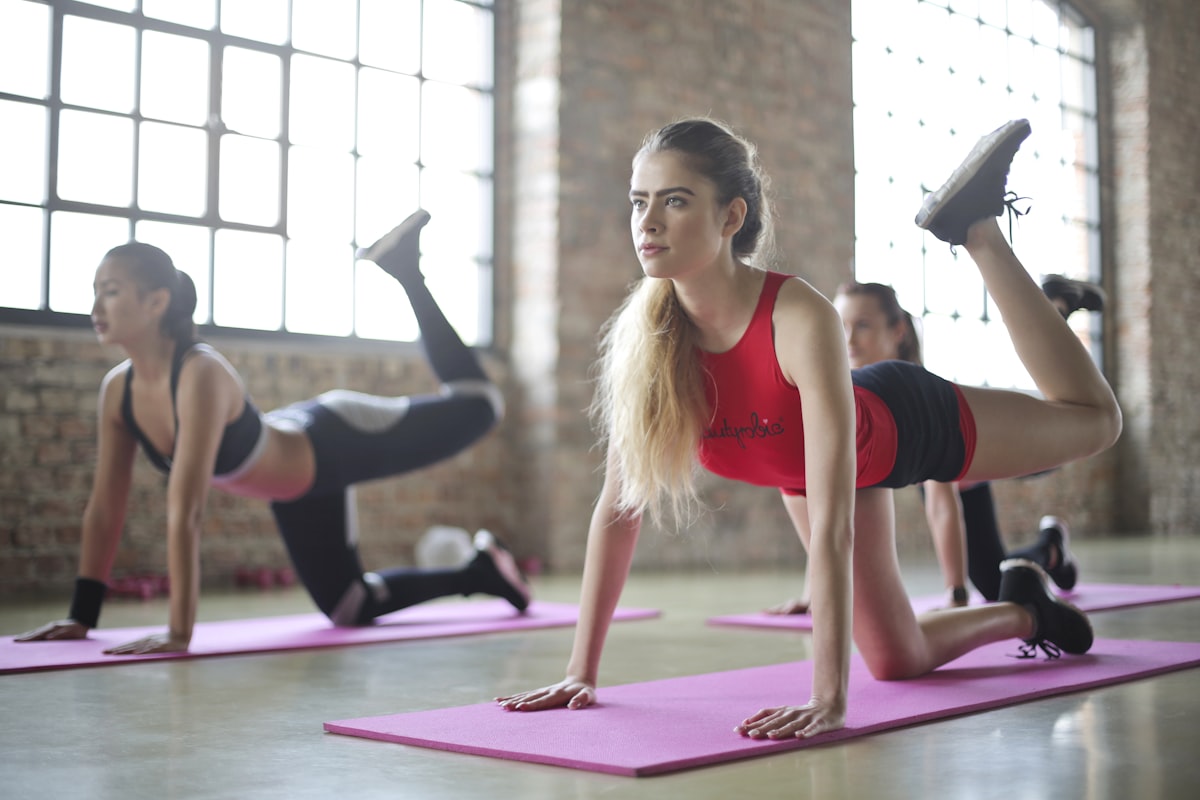
In my studio in Utah, I’ve developed a go-to sequence for golfers that I come back to again and again because it works. These aren’t exotic movements. They’re foundational Pilates exercises applied with intention toward rotational sport demands.
1. Mermaid on the Reformer
This is the single best exercise for thoracic side-bending and rotation. It opens the lats, the obliques, and the intercostals — all the muscles that get dense and short from sitting and from one-directional swinging. I cue my clients to think about creating space between every rib. When they do it right, you can almost hear their spine sigh.
2. Rotation on the Long Box
Lying prone on the long box with arms in straps, you extend and rotate. This combines spinal extension with rotation — exactly the movement pattern of the backswing. It strengthens the posterior chain while teaching the thoracic spine to move independently.
3. Supine Hip Work (Frogs and Circles)
These exercises move the femur through its full range of motion while the pelvis stays stable on the carriage. For golfers, this translates to hip rotation that doesn’t leak into the lower back. I’ve had clients gain 10-15 degrees of hip rotation within a month of consistent practice.
4. Knee Stretch Series (Round Back)
This builds deep core stability and hamstring flexibility simultaneously. The round-back version also teaches spinal flexion with control — the opposite of the extension pattern in your swing. Balanced spinal mobility is everything.
5. Standing Arm Work with Rotation
Using the reformer’s straps while standing, we add rotational patterns that mimic the follow-through. This is where Pilates meets sport-specific training, and it’s where my golf clients feel the most direct carryover to their game.
What I See Change in Golfers Who Commit to Pilates
I’m going to be honest: one session won’t transform your golf swing. But golfers who come to my studio two to three times per week consistently — I’m talking 6 to 8 weeks — report changes that genuinely surprise them.
“I had a client in Sandy — a guy in his 50s, been playing golf his entire adult life — who came to me because his lower back was wrecked after every round. Within two months of reformer Pilates, his back pain was gone. But the thing he couldn’t stop talking about was his swing. He said he could feel himself rotating through the ball for the first time in years. His driving distance increased by 15-20 yards. He didn’t change his club, his coach, or his technique. He changed his body.”
Here’s what typically shifts:
- Increased backswing range — more rotation means a bigger arc, which means more power without more effort
- More consistent contact — when your body can hold its posture through the swing, you strike the ball more cleanly
- Less pain after 18 holes — the lower back, neck, and shoulders stop taking the punishment meant for the hips and thoracic spine
- Better balance and weight transfer — Pilates builds proprioception that translates directly to a smoother swing
- Improved focus and body awareness — you start to feel when your body is compensating, which means you can self-correct on the course
Pilates for Golf Flexibility: Getting Started in Utah

If you’re a golfer along the Wasatch Front — Salt Lake City, Cottonwood, Draper, Lehi, Utah County — and you’ve been ignoring flexibility, your body is keeping score even if you’re not. The good news is that Pilates meets you where you are. You don’t need to be flexible to start. You need to start to become flexible.
At Alchemize Pilates, I teach small-group reformer classes and private sessions that I can tailor to your specific restrictions and goals. If you tell me you’re a golfer, I know exactly where to look: your hips, your thoracic spine, your shoulder girdle. We build from there. Check out our class formats and ask me what’s running, or book a session directly if you want one-on-one attention.
I’m also the first person to tell you that Pilates isn’t the only path. Yoga, mobility drills, physical therapy, TPI-certified golf fitness training — all of these have value. What I know from my own teaching experience is that the reformer gives golfers something rare: resistance-based flexibility training that transfers directly to the course. It’s not just stretching. It’s building a body that can actually do what your swing is asking it to do.
If you’ve been playing through stiffness, playing through pain, or watching your distance shrink year after year — pilates for golf flexibility might be the thing that gives your game a second life. Your body changes when you train it with intention. Your golf follows.
— Bianca
Frequently Asked Questions: Pilates for Golf Flexibility
How often should golfers do Pilates to improve flexibility?
I recommend two to three reformer Pilates sessions per week for noticeable improvements in golf flexibility. Most of my golfer clients begin to feel significant changes in thoracic rotation and hip mobility within 6 to 8 weeks of consistent practice. Even one session per week can help maintain range of motion during the golf season.
Can Pilates help with golf-related lower back pain?
Yes — in many cases, golf-related lower back pain stems from limited hip and thoracic spine mobility, which forces the lumbar spine to absorb excessive rotational force. Pilates addresses both the flexibility deficits and the core stability needed to protect the lower back during the golf swing. If you have a diagnosed injury, work with your doctor or physical therapist alongside Pilates.
Is reformer Pilates better than mat Pilates for golfers?
Both have value, but I find the reformer particularly effective for golfers because the spring resistance provides feedback and support that allows deeper, more controlled stretching. The carriage also creates an unstable surface that challenges balance and proprioception — two qualities that directly improve golf performance. Mat Pilates is a wonderful supplement, especially for travel or practice days.
Do I need to be flexible already to start Pilates?
Absolutely not. Some of my stiffest clients are golfers who walk in barely able to rotate their upper body. The reformer is adjustable — springs can be lightened, ranges can be modified, and every exercise can be scaled to your current ability. You don’t need flexibility to start Pilates; you start Pilates to build flexibility.
Will Pilates actually increase my driving distance?
It can. Driving distance is largely determined by clubhead speed, which depends on how much rotational range of motion you can create and control. When Pilates increases your thoracic rotation and hip mobility, your swing arc naturally gets bigger, generating more speed without more muscular effort. Several of my clients have reported gains of 10 to 20 yards after committing to a regular Pilates practice.

Leave a Reply