Pilates for Runners Recovery: Why the Best Thing You Can Do After a Run Is Get on a Reformer
Cross-training that actually heals — not just hurts differently.
If you’ve ever laced up for an early morning loop on the Bonneville Shoreline Trail, you know the feeling. The Wasatch Front air on your face, the rhythm of your stride, and then — hours later — the ache that sets into your hips, your IT band, your lower back. I started exploring pilates for runners recovery years ago when I noticed a pattern in my studio: runner after runner arriving in Draper or Sandy with the same complaints, the same tightness, the same injuries on repeat. What I’ve learned since then has changed the way I teach and the way my clients run.
This isn’t about replacing your miles. It’s about making every mile sustainable.
Why Runners Need a Recovery Strategy Beyond Stretching
Running is beautiful in its simplicity. One foot in front of the other. But that simplicity comes at a cost: repetitive movement in a single plane of motion, thousands of times per session. Over weeks and months, imbalances build. The quads dominate. The hip flexors shorten. The glutes — which should be your powerhouse — fall asleep.
I see this with my clients constantly. A marathoner from Lehi who couldn’t figure out why her knees ached despite strong quads. A trail runner in Park City whose lower back spasmed every time he hit mile 8. In almost every case, the issue wasn’t weakness in the obvious muscles. It was weakness in the ones they couldn’t see — and hadn’t been training.
Static stretching helps. Foam rolling helps. But neither reprograms the way your body moves. That’s where Pilates — specifically reformer Pilates — fills a gap that nothing else does.
How Pilates for Runners Recovery Works on the Reformer
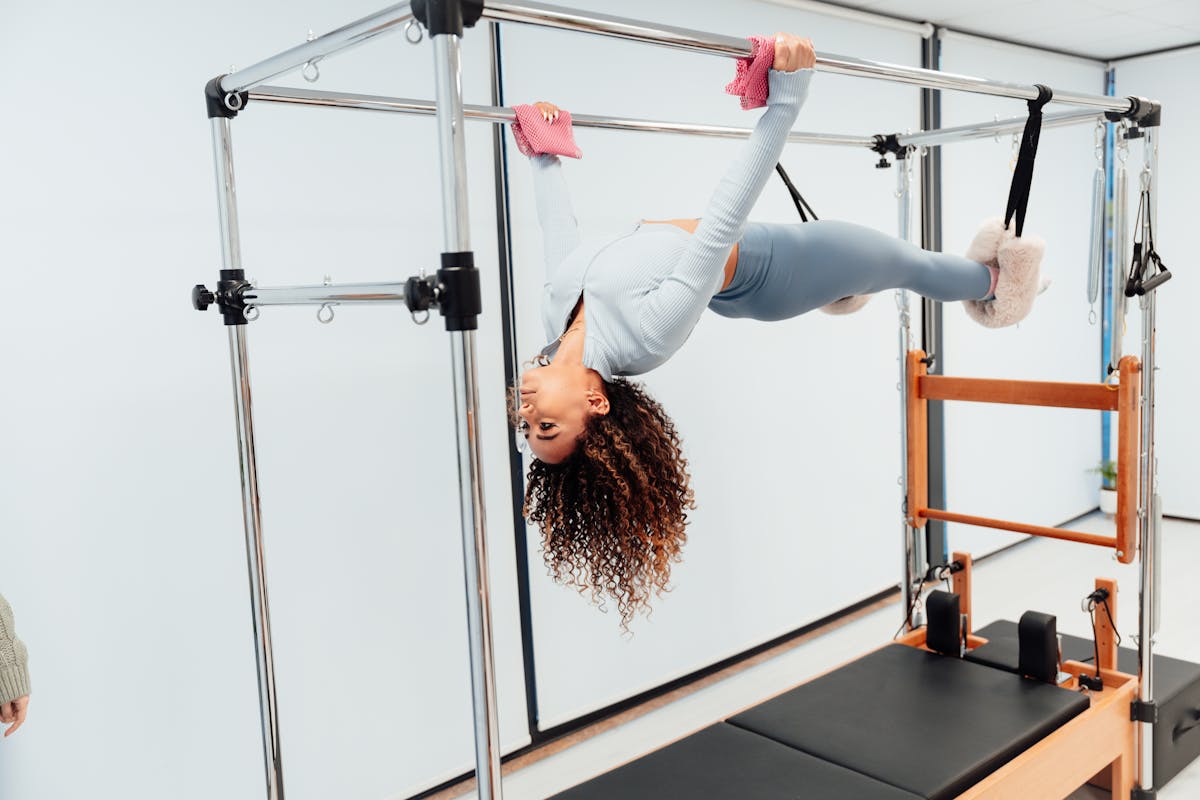
The reformer isn’t just a fancy bed with springs. It’s a feedback machine. The spring resistance creates load without impact. The gliding carriage demands stabilization from your deep core while your limbs are in motion. This is exactly what your body needs post-run: controlled movement under tension, without pounding your joints further.
Here’s what reformer Pilates specifically targets for runners:
- Glute activation and hip stability: Footwork variations, bridging on the carriage, and lateral leg spring work wake up the gluteus medius — the muscle most runners under-recruit.
- Hip flexor lengthening under control: The reformer allows hip extension through exercises like lunges on the carriage, creating length and strength simultaneously. This is different from a passive stretch.
- Deep core integration: Not crunches. I’m talking about transversus abdominis, pelvic floor, and multifidus engagement — the muscles that keep your pelvis stable when your foot strikes the ground 1,500+ times per mile.
- Ankle and foot proprioception: The unstable surface of the reformer carriage trains your foot’s intrinsic muscles. Runners who do this have fewer ankle sprains and better trail awareness.
- Spinal decompression and thoracic mobility: After being compressed with every footfall, your spine needs space. Exercises like the long stretch and mermaid on the reformer create exactly that.
Joseph Pilates developed his method in the 1920s with rehabilitation in mind — it was designed for bodies that needed to heal and move better. Running recovery is one of its most natural applications.
The Imbalances Running Creates (and Pilates Corrects)
Let me be specific, because vague promises don’t help anyone.
Running is a sagittal-plane-dominant activity. You move forward. That’s it. You rarely move laterally, you rarely rotate, and you rarely decelerate in a controlled way. Over time, this creates predictable patterns:
- Quad dominance over hamstrings and glutes. Your quads fire to absorb impact. Your glutes should propel you. But because most of us sit all day before we run, the glutes are inhibited, and the quads do double duty.
- Tight hip flexors, weak hip extensors. Sitting shortens the psoas and iliacus. Running never fully corrects this because your hip rarely reaches full extension at conversational pace.
- Ankle rigidity. Running on flat surfaces — sidewalks in Sandy, paved paths in Cottonwood — doesn’t challenge your ankles through their full range. The joint stiffens, increasing strain on the knees above.
- Rotational neglect. Your trunk should counter-rotate as you run — left arm swings forward as right leg drives. But without training that rotation, the obliques and deep spinal muscles weaken, and your lower back takes the load.
In my reformer classes at Alchemize, I program exercises that specifically address each of these patterns. We move in all three planes. We work eccentrically — lengthening muscles under load — which is critical for injury prevention. And we do it all with springs that adapt to your strength, not a barbell that doesn’t care.
When to Add Pilates to Your Running Schedule
Timing matters. I’m not going to tell you Pilates replaces your recovery day — it becomes part of it.
Here’s what I recommend to the runners I work with along the Wasatch Front:
- Day after a long run: A gentle reformer session focused on mobility, spinal decompression, and glute activation. Low spring tension. Think recovery, not intensity.
- Mid-week between speed sessions: A moderate reformer class targeting hip stability, single-leg work, and core endurance. This builds the stabilizers that protect you during intervals.
- Pre-race taper week: One or two reformer sessions to maintain mobility without adding fatigue. Keep it light. Keep it restorative.
What I don’t recommend: doing a heavy Pilates class the same day as your speed work or tempo run. Your neuromuscular system needs to prioritize one stimulus at a time. Be honest with your body about what it needs on any given day.
Real Results I’ve Seen in My Studio
I want to share a few stories from my teaching at Alchemize, because theory only goes so far.
One of my clients — a woman in her late 40s training for the Salt Lake City Marathon — came to me with chronic piriformis syndrome. She’d tried physical therapy, stretching protocols, even cortisone injections. After eight weeks of twice-weekly reformer sessions focused on glute medius strengthening and hip flexor mobility, her piriformis pain was gone. She finished her marathon and texted me from the finish line.
Another client, a college-aged trail runner from Utah County, had recurring shin splints. We discovered through our sessions that his calves were doing almost all the propulsion work — his glutes barely fired during single-leg exercises. We reprogrammed that pattern on the reformer over about six weeks. His shin splints didn’t return that season.
I’m not claiming Pilates cures injuries. I’m saying it addresses the movement dysfunctions that cause them. There’s a difference, and it matters.
Pilates for Runners Recovery vs. Other Cross-Training
I believe in honesty, so let me acknowledge: Pilates isn’t the only cross-training that helps runners. Swimming is excellent for active recovery. Cycling builds leg endurance without impact. Yoga improves flexibility and mindfulness.
But here’s where Pilates — especially reformer Pilates — has an edge for recovery specifically:
- Spring resistance is adaptive. Unlike weights, springs get harder through the range of motion, which is gentler on joints at the start position and more challenging at end range — exactly where runners are weakest.
- It’s corrective, not just general. A good instructor can spot your imbalances in real time and adjust. That’s hard to do in a pool or on a bike.
- It trains the mind-body connection. Running is often autopilot. Pilates forces you to feel where you’re compensating. That awareness transfers back to your stride.
If you’re curious about what a session feels like, I’d invite you to book your first class at Alchemize and experience it yourself. Most runners are surprised by how much they feel working — and how little it aggravates their existing aches.
Building a Sustainable Running Practice Along the Wasatch Front
We live in one of the most extraordinary running landscapes in the country. From the alpine trails above Park City to the flat, fast paths through Draper and Sandy, there’s terrain for every kind of runner here. But those same trails — the elevation changes, the uneven surfaces, the hard-packed dirt — demand more from your body than a treadmill ever could.
That demand is what makes pilates for runners recovery not just useful but essential for longevity in the sport. I’ve seen too many passionate runners sidelined by injuries that were entirely preventable. IT band syndrome, plantar fasciitis, runner’s knee, stress fractures — these aren’t inevitable. They’re signals that your body needs more than just miles.
It needs balance. It needs correction. It needs the kind of intentional, intelligent movement that reformer Pilates provides.
If you’re a runner looking for something that makes your body feel whole again after a hard effort, explore our class formats at Alchemize Pilates. We’re here for you — not to change what you love, but to help you keep doing it for decades.
— Bianca
Frequently Asked Questions About Pilates for Runners Recovery
How often should runners do Pilates for recovery?
I recommend two reformer Pilates sessions per week for most runners. One should be a lighter, mobility-focused session after your long run, and one can be a moderate-intensity class mid-week that targets stability and core strength. During taper weeks before a race, reduce to one gentle session. Consistency matters more than frequency — even one session per week produces noticeable results within six to eight weeks.
Can Pilates help with IT band syndrome from running?
Yes, and this is one of the most common issues I address in my studio. IT band syndrome in runners is almost always linked to weak glute medius muscles and poor hip stability. Reformer Pilates exercises like lateral leg spring work, side-lying series, and single-leg bridging directly strengthen the muscles that support the IT band. Many of my clients see significant improvement within four to six weeks of consistent practice.
Is reformer Pilates better than mat Pilates for runners?
For recovery purposes, I believe the reformer has a meaningful edge. The spring resistance allows you to work muscles through their full range of motion with adjustable load, which is ideal for addressing imbalances without adding impact stress. Mat Pilates is wonderful and accessible, but the reformer gives both the instructor and the client more tools to target specific weaknesses — especially in the hips, ankles, and deep core.
Should I do Pilates before or after a run?
For recovery purposes, after is better — ideally the day after a hard run rather than immediately after. Your muscles need blood flow and gentle movement to recover, not more intense work layered on top of fatigue. If you want to do Pilates on the same day as an easy run, do your run first, rest for a few hours, then take a gentle reformer session. Avoid combining Pilates with speed work or tempo runs on the same day.
Will Pilates actually make me a faster runner?
Indirectly, yes. Pilates won’t build your VO2 max or increase your lactate threshold — that’s what your running training does. But by improving your hip stability, core strength, and movement efficiency, Pilates reduces energy leaks in your stride. Many of my running clients report feeling “smoother” and more efficient within a few weeks. Less wasted motion means more energy going toward forward propulsion. Over a long race, that adds up.

Leave a Reply